

Why This Comparison Matters
Choosing the wrong VPS provider for WordPress hosting can cost you. You might pay three times more for identical performance, or worse, select a provider with poor latency for your target audience. The difference between a site that loads in 400ms and one that takes 1.2 seconds often comes down to where your server lives and how well the underlying infrastructure performs under load.
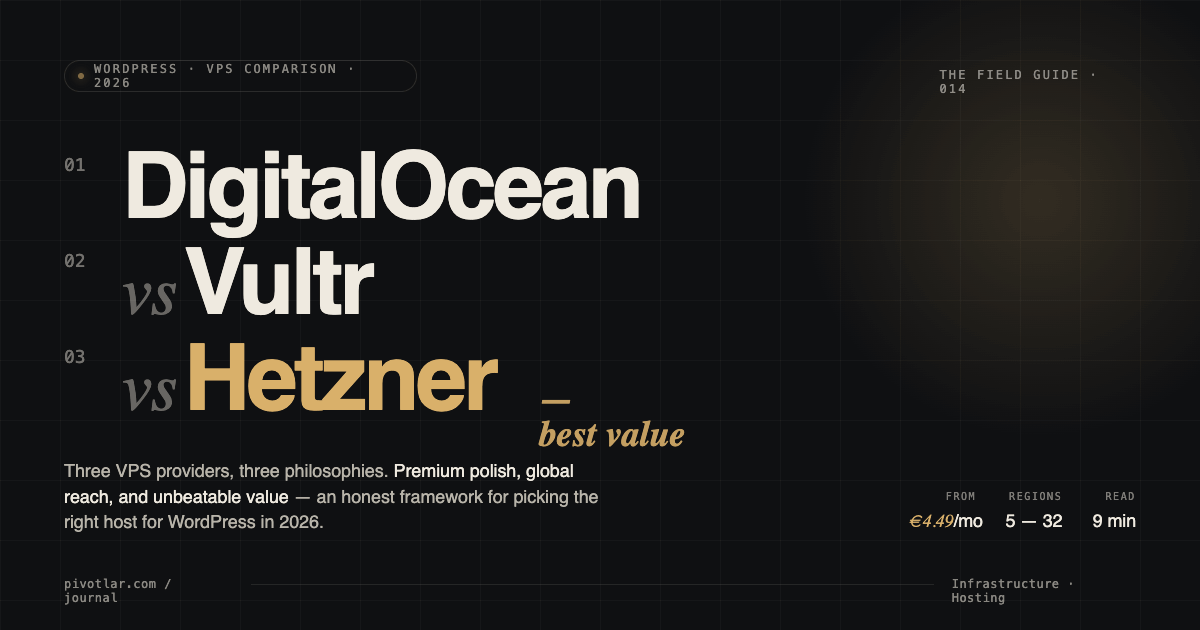
In 2026, DigitalOcean, Vultr, and Hetzner remain three of the most popular choices for developers and agencies managing WordPress sites on virtual private servers. Each has distinct strengths and weaknesses. This comparison gives you the information you need to make an informed decision based on your specific requirements, not marketing copy.
Quick Overview of Each Provider
DigitalOcean has built a reputation on developer experience. Their documentation is consistently excellent, their UI is polished, and their brand recognition means most developers have used them at some point. They target startups and growing businesses willing to pay a premium for reliability and ease of use. Droplets (their VPS offering) are straightforward to provision and manage.
Vultr occupies a middle ground between premium and budget providers. They offer competitive pricing, good global coverage with data centers across six continents, and a flexible product lineup that includes bare metal servers alongside standard VPS instances. They are less well-known than DigitalOcean but have steadily improved their platform over the past few years.
Hetzner is a German provider with a strong reputation in Europe. They offer exceptional value for money, with performance that often exceeds providers charging double their rates. Their infrastructure is primarily EU-based, though they have expanded to the US. The trade-off is a less polished interface and smaller ecosystem compared to DigitalOcean.
Head-to-Head Breakdown
Here is how the three providers compare across key criteria for WordPress hosting:
When it comes to pricing, Hetzner is the clear winner on paper. Their entry-level plan starts at around €4.49 per month (roughly $4.90), compared to Vultr at $5 and DigitalOcean at $6. The gap looks small in isolation but adds up quickly when you are running a dozen servers for client sites.
Data center coverage tells a different story. Vultr leads with 32 locations spread across 6 continents, giving you the most flexibility for targeting specific regions. DigitalOcean offers 15 regions globally, which is more than enough for most use cases. Hetzner is the most limited here, with only 5 locations — three in Europe and two in the US — which is fine if your audience sits in those regions but a real constraint if you need Asia-Pacific coverage.
On network performance, DigitalOcean is the most consistent across the board. Vultr is generally solid but performance can vary depending on which location you deploy to. Hetzner punches well above its price in Europe, with excellent throughput and low latency for EU-based workloads. Its US nodes are decent but not exceptional.
Pricing reflects early 2026 rates. Always verify current pricing directly on each provider's website before committing, as promotional rates and regional variations apply.
DigitalOcean: Premium Experience, Premium Price
DigitalOcean's strongest asset is developer experience. Their control panel is intuitive, provisioning is fast, and their documentation covers nearly every common scenario you will encounter when setting up WordPress. If you need to spin up a server, configure DNS, attach block storage, and set up automated backups, DigitalOcean makes these tasks straightforward.
The API is mature and well-supported by infrastructure-as-code tools like Terraform. Automation is reliable, which matters if you manage multiple sites or need to provision environments programmatically. Their marketplace includes one-click WordPress installations, though if you are technical enough to consider VPS hosting, you likely prefer more control over your stack.
Support is ticket-based and generally responsive within a few hours. You will not get phone support at the entry tier, but written responses are usually helpful and technically accurate.
The downside is cost. You pay roughly 20-30% more than Vultr and significantly more than Hetzner for equivalent resources. For small projects or budget-conscious agencies, this premium adds up quickly when you are running a dozen or more instances.
Vultr: Flexible and Globally Distributed
Vultr offers a solid middle option. Their pricing undercuts DigitalOcean slightly while maintaining good performance. With 32 data center locations, they provide more geographic flexibility than either competitor. This matters if you serve clients in regions like Southeast Asia, South America, or Australia, where both DigitalOcean and Hetzner have limited presence.
The control panel is functional but less polished than DigitalOcean's. It gets the job done without unnecessary complexity. Their API works well for automation, though documentation is not quite as comprehensive. You may occasionally need to reference community forums for edge cases.
Network performance varies by location. Their European and US infrastructure performs well, but some newer regions occasionally show higher latency variability under load. For most WordPress sites, this difference is negligible, but it is worth testing if you are serving latency-sensitive applications.
Support quality is acceptable but not exceptional. Ticket response times are reasonable during business hours, though complex issues sometimes require back-and-forth exchanges that stretch resolution time.
Vultr's value proposition is flexibility and geographic reach at a reasonable price. If you need servers in multiple continents or want to avoid putting all infrastructure with one provider, Vultr is a sensible choice.
Hetzner: Unbeatable Price-to-Performance
Hetzner stands out for one reason: you get significantly more resources for your money. A server that costs $20/month at DigitalOcean might run $10-12 at Hetzner with comparable or better performance. Their CPUs are often newer generation, and disk I/O is consistently fast.
If your traffic is primarily European, Hetzner should be your default choice. Network performance within Europe is excellent, and latency to major EU cities is typically under 20ms. Their Falkenstein and Nuremberg data centers are particularly well-connected.
The US presence is newer and smaller, with data centers in Virginia and Oregon. Performance is good but not as dominant as their EU infrastructure. If you serve primarily US traffic, you are better off with DigitalOcean or Vultr unless budget is the overriding concern.
The trade-offs are a less mature ecosystem and slower support. Hetzner's interface is functional but dated. Their API works but lacks the polish of DigitalOcean's. Documentation exists but is less comprehensive. Support is email-only and can take 24-48 hours for non-urgent issues.
For developers comfortable troubleshooting independently and agencies managing costs across many client sites, these compromises are worth the savings. If you prefer not to spend time working around platform limitations, the extra cost of DigitalOcean may be justified.
Which One Should You Pick
The best choice depends on your specific situation:
Best for US-Based Projects
DigitalOcean or Vultr. DigitalOcean if you value polish and are willing to pay for it. Vultr if you want to save 15-20% without sacrificing much. Hetzner works but is not optimal for US-only traffic.
Best for European Projects
Hetzner, without question. The price-to-performance ratio is unmatched, and network performance within Europe is excellent. Unless you need features specific to DigitalOcean's platform, there is little reason to pay double.
Best for Budget-Conscious Setups
Hetzner for EU traffic, Vultr for global. If every dollar matters and you are comfortable with a less polished experience, Hetzner delivers the most compute per dollar spent.
Best for Agencies Managing Many Client Sites
This is where provider choice becomes less critical. If you use a server management platform like Pivotlar, provisioning, SSL management, deployment, and monitoring are abstracted away. Whether your VPS runs on DigitalOcean, Vultr, or Hetzner, your day-to-day workflow remains identical. You connect your VPS via API, and Pivotlar handles the rest. In this scenario, optimize for cost and regional performance rather than platform features, since you are not interacting directly with the provider's control panel most of the time.
The Bottom Line
DigitalOcean is the safest choice if you want polish and are willing to pay for it. Vultr offers a good balance of price, performance, and global reach. Hetzner delivers unbeatable value for European traffic and budget-focused deployments. For most WordPress hosting scenarios in 2026, you cannot go wrong with any of these three, but picking the right one for your specific use case can save you significant money or improve performance measurably. Evaluate your primary traffic region, budget constraints, and how much you value platform maturity, then choose accordingly.