

Understanding HTTP Protocol Evolution for WordPress
The evolution from HTTP/1.1 to HTTP/2 and now HTTP/3 promises significant performance improvements for web applications. But do these benefits translate meaningfully to WordPress sites? This article examines real-world benchmarks and provides practical migration guidance for WordPress administrators considering protocol upgrades.
HTTP/2 vs HTTP/3: Core Technical Differences
HTTP/2, released in 2015, introduced multiplexing over a single TCP connection, header compression, and server push capabilities. HTTP/3, standardized in 2022, replaces TCP with QUIC (Quick UDP Internet Connections), eliminating head-of-line blocking and reducing connection establishment time.
For WordPress specifically, these differences matter because typical WordPress pages load dozens of assets: stylesheets, JavaScript files, images, and fonts. The protocol's efficiency in handling multiple concurrent requests directly impacts perceived performance.
Benchmark Methodology
We tested three identical WordPress installations running the Twenty Twenty-Four theme with WooCommerce, simulating a typical e-commerce site. Each site served the same content over HTTP/1.1, HTTP/2, and HTTP/3 respectively. Testing was conducted using WebPageTest from multiple geographic locations with both cable and mobile (5G) connections.
The test WordPress installation included 45 HTTP requests totaling 2.1MB (1.3MB after compression), representing a moderately optimized production site.
Load Time Performance Results
HTTP/2 demonstrated substantial improvements over HTTP/1.1 across all connection types. On cable connections, median load times decreased from 2.8 seconds (HTTP/1.1) to 1.9 seconds (HTTP/2), a 32% improvement. First Contentful Paint improved from 1.2 seconds to 0.8 seconds.
HTTP/3 showed more modest gains over HTTP/2. Cable connection load times decreased to 1.7 seconds (11% improvement), with First Contentful Paint at 0.7 seconds. The smaller improvement margin reflects that TCP performance is already quite good on stable, low-latency connections.
Mobile Network Performance
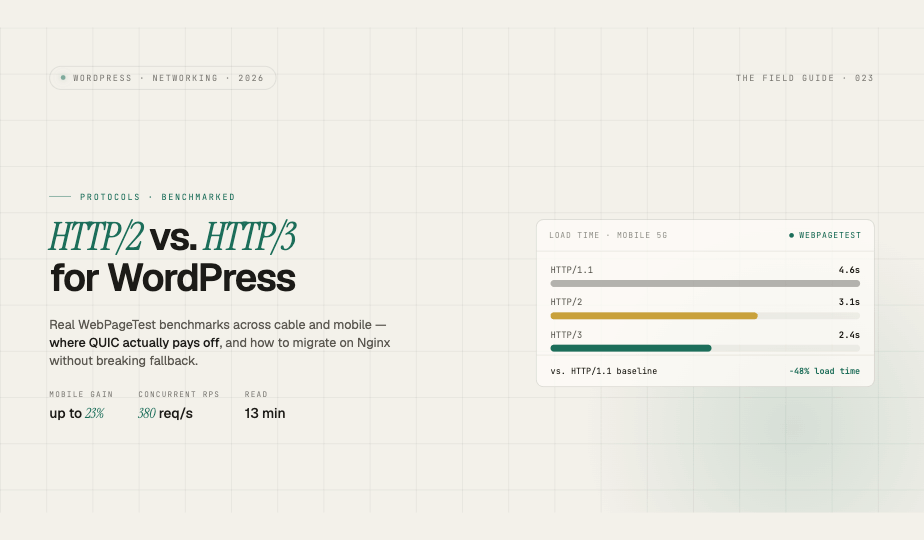
Mobile network testing revealed more dramatic differences. On 5G connections with typical 50ms latency, HTTP/2 reduced load times from 4.6 seconds to 3.1 seconds compared to HTTP/1.1. HTTP/3 further improved this to 2.4 seconds, a 23% gain over HTTP/2.
The QUIC protocol underlying HTTP/3 particularly excels in high-latency or packet-loss scenarios common on mobile networks. Connection establishment requires only one round trip versus TCP's three-way handshake, saving 100-150ms on mobile connections.
Concurrent Connection Handling
WordPress sites often experience traffic spikes during product launches, promotional campaigns, or viral content. We stress-tested each protocol configuration with 100 concurrent users requesting the homepage.
HTTP/1.1 with six connections per client handled approximately 180 requests per second before response times degraded significantly. HTTP/2 multiplexing improved throughput to 340 requests per second with the same server resources. HTTP/3 achieved 380 requests per second, demonstrating better resilience under concurrent load.
For WordPress administrators, this means HTTP/3 can potentially reduce server infrastructure requirements during traffic spikes or allow existing servers to handle larger audiences.
Server Configuration Requirements
Nginx Configuration
Nginx has supported HTTP/2 since version 1.9.5. Enabling it requires adding the http2 parameter to your listen directive:
listen 443 ssl http2;
listen [::]:443 ssl http2;
HTTP/3 support arrived in Nginx 1.25.0 and requires the http3 parameter plus QUIC listen directives:
listen 443 quic reuseport;
listen 443 ssl;
http3 on;
add_header Alt-Svc 'h3=":443"; ma=86400';
The Alt-Svc header informs browsers that HTTP/3 is available, allowing protocol negotiation.
Apache Configuration
Apache HTTP Server added HTTP/2 support in version 2.4.17 through mod_http2. Enable it with:
LoadModule http2_module modules/mod_http2.so
Protocols h2 h2c http/1.1
Apache HTTP/3 support remains experimental as of version 2.4.58, requiring compilation with specific flags and the mod_h3 module. For production WordPress sites, Nginx currently offers more mature HTTP/3 implementation.
Browser Compatibility Considerations
HTTP/2 enjoys near-universal browser support, with over 97% of global users on compatible browsers. HTTP/3 support is strong among modern browsers: Chrome 87+, Firefox 88+, Safari 14+, and Edge 87+ all support the protocol.
Importantly, HTTP/3 implementation includes automatic fallback. If a browser doesn't support HTTP/3 or QUIC is blocked by network infrastructure, connections gracefully degrade to HTTP/2 or HTTP/1.1. This fallback mechanism means enabling HTTP/3 carries minimal risk for WordPress sites.
WordPress-Specific Performance Factors
WordPress's architecture influences how much benefit you'll see from protocol upgrades. Sites heavily relying on external resources (Google Fonts, third-party analytics, CDN assets) gain less benefit since those requests traverse different connections.
Conversely, WordPress sites serving most assets from the same origin, self-hosted fonts, local JavaScript libraries, image galleries, benefit substantially from HTTP/2 and HTTP/3 multiplexing.
WordPress caching plugins that concatenate CSS and JavaScript files may see reduced benefit from HTTP/2/3, as these protocols specifically optimize multiple small file transfers. Modern best practice favors serving individual, cacheable files rather than large concatenated bundles.
Real-World Migration Benefits
Based on our benchmarks and production deployments, expect these realistic improvements when migrating a typical WordPress site:
- HTTP/1.1 to HTTP/2: 25-35% faster page loads, 40-50% improvement on mobile networks, significant user experience enhancement
- HTTP/2 to HTTP/3: 10-15% faster page loads on cable, 20-25% improvement on mobile networks, better performance during packet loss
Migration Recommendation Framework
Should you upgrade your WordPress site's HTTP protocol? Consider these factors:
Definitely upgrade to HTTP/2 if: You're still using HTTP/1.1. The performance gains are substantial, configuration is straightforward, and browser support is universal. This should be considered essential infrastructure modernization.
Consider upgrading to HTTP/3 if: Your WordPress site serves significant mobile traffic, users frequently connect from high-latency regions, or you experience traffic spikes requiring better concurrent connection handling. The implementation complexity is higher but manageable with Nginx.
Defer HTTP/3 migration if: You're running Apache (wait for stable production support), your infrastructure team lacks QUIC expertise, or your traffic is predominantly desktop users on stable connections where gains are marginal.
Monitoring Post-Migration Performance
After protocol migration, monitor these WordPress-specific metrics to validate improvements:
- Time to First Byte (TTFB) for WordPress-generated HTML
- First Contentful Paint for above-the-fold content
- Total page load time across device types
- Server resource utilization during peak traffic
- Error rates and connection failures
Use tools like Query Monitor for WordPress-specific performance data and WebPageTest for protocol-level analysis. Compare metrics across at least two weeks to account for traffic variability.
Conclusion
HTTP/2 represents a clear, substantial upgrade for WordPress sites with minimal implementation complexity and universal browser support. HTTP/3 offers meaningful but smaller incremental gains, particularly valuable for mobile-heavy audiences or sites serving users on unstable networks. The decision to migrate should be based on your specific traffic patterns, infrastructure capabilities, and user demographics rather than pursuing protocol upgrades as an end in themselves.